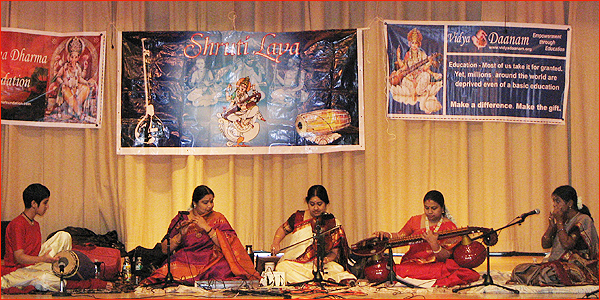
In the 1970s an ensemble of string / wind instruments (Violin / Venu / Veena) was pioneered by the violin maestro Lalgudi Jayaraman and brought to the US in 1971.
The phenomenal success of that Quartet (Violin - Venu / Flute - Veena - Mridangam) during the tour demonstrated the limitless horizons and scope for blending tradition and innovation in Carnatic music.
The fact that the original concept was still viable and vibrant was amply vindicated, even after the passing of three decades by the ‘all women’ ensemble which calls itself “Vadya Sunadha Sangamam” which toured the United States recently.
The concert tour is being sponsored as part of a fund raising endeavor by Sanatana Dharma Foundation, an US-based charitable organization affiliated to AIM for SEVA Foundation established by Pujya Swamiji Dayanandha Saraswathi.
New York (Queens) was the venue for the concert by this young quartet on April 5, 2009. The All Women Ensemble consisted of Lalgudi Vijayalakshmi (Violin), Mala Chandrasekhar (Flute), Jayashree Jairaj (Veena) , Rajna Swaminathan (Mridangam) and Bhagyalakshmi Muralikrishna (Morsing).
The fact that both Lalgudi Vijayalakshmi and Mala Chandrasekhar are seasoned veterans in their individual capacities with strings of concerts and overseas tours for over two decades, lent an ‘aura” of experience and stage presence. This was evidenced by the 'pitch-perfect' harmony amongst the diverse instruments and the steady and soothing tonal quality of the violin-flute-veena combo, added to the dignity of the concert.
The concert started with a Varnam in the raga Devamanohari (composed by Lalgudi Vijayalakshmi herself - a fact belatedly made known to this writer after lots of coaxing). The swara phrases were brisk and crisp setting the tone for the whole concert.
This was followed by Dikshitar’s popular composition in praise of Lord Ganesha (in Shanmughapriya) 'Siddhi Vinayakam'. The raga elaboration was brief and impressive. Next came Evarura in Mohanam (Tygaraja composition), with Raga delineation by Mala rendered soothingly and methodically with lot of bhavam and feeling that the piece demanded.
Full justice was done by the ensemble in the Neraval and Swara phases of the song with the proper balance and sense of proportion (no breakaway-out-of-turn solo outbursts by any of the artistes hindering the steady tempo!). The next piece in Panthuvarali (Tyagaraja’s composition Siva Siva) was taken up by Jayashree (Veena). The raga delineation was pleasant and the serene nature of the Raga was exquisitely brought out through the smooth fingering and gentle plucking of the strings. Vijayalakshmi then took up Raga Hemavathi bringing out the richness of this Melakarta Raga embracing the contours of the Krithi that followed - Sreekanthimatheem (Dikshitar). This piece ended with a brilliant duet on the mridangam and morsing.
Rajna's choice of rhythmic permutations and their execution was flawless upholding the tradition of her guru Umayalpuram Sivaraman. Bhagyalakshmi on the morsing was also good. A stringed instrument thro’ which rhythmic phrases are vocally “sputtered”, the morsing is a difficult instrument to play and Bhagyalakshmi proved herself to be a fitting foil for the young Rajna much to the delight and appreciation of the audience.
The next item was the Main Ragam-Tanam-Pallavi in Brindavanasaranga by Vijayalakshmi. This Raga is an import from Hindusthani music into Carnatic music and has been immortalized by Dikshitar through his compositions. Vijayalakshmi adhered to the spirit of the raga in her step-wise, methodical and sensitive delineation. The Pallavi was set to Kanda Jathi Triputa Thala (9 beats)—simple but elegant without any rhythmic overkill. This was followed by a Ragamalika Swarams (Sama, Kalyanavasantham, Narthaki and Bhagyashree) rendered smoothly and crisply.
The tail pieces were the popular Gopala Krishna Bharathi composition in Jonpuri (Eppo Varuvaro) and the Thillana in Maund (composed by Lalgudi Jayaraman). The concert concluded with the traditional mangalam.
Overall, the concert was notable for its orchestral balance and melody with the proper combination of tradition and innovation. The auditory experience was enriched by the superb acoustics of the audio system ably managed by Srinadh of Sruthi Laya - the sponsors of the concert.
During the concert Dr. Krishnan Ramaswami elaborated on the objectives and accomplishments of the Foundation and stressed the need for generous contributions. The event concluded with a vote of thanks by Nirmala Ramasubramanian.