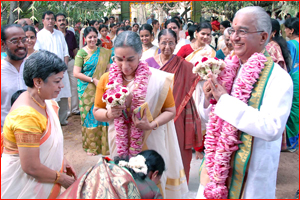
For me, the best thing about the tribute to Shantha and V. P. Dhananjayan on his 70th birthday and both of them receiving the Padma Bhushan award was what was gained in the planning of it.
We, the senior students who met to plan the event, bonded very beautifully after many of us had moved on and found our wings and were flying in different directions. What fun we had putting this event together!
Leela Samson of Kalakshetra readily agreed to let us lease the Rukmini Arangham for the event which was very significant as Shantha and Dhananjayan met and fell in love and married in Kalakashetra.
Radhika Shurajeet thought of a Harikatha on Dhananjayan and so approached Girija Ramaswamy who is, besides being a regular vocal accompanist for Bharathanatyam performances, been a school teacher at PSBB, currently teaching at the Government of Tamilnadu College of Music and dance.
She was very enthusiastic - she is familiar with the life of the Dhananjayans and the ambience of Bharatha Kalanjali. So I took charge of creating an interactive narration with her in the Harikatha style. I also felt we should bring in the lotus theme for the evening - lined to the Padma Bhushan.
Madhu Krishna designed a beautiful invitation card and when Shanthakka saw it, she revealed to us that Dhananjayan's signature in every loving letter he wrote to her was a lotus. We had ordered for 1500 lotuses for the decoration in Kalakshetra and for the garlands. Everyone was sworn to secrecy so the Dhananjayans had no idea of what they were to expect that evening.
The one thing that brought tears to their eyes was the presentation of the 'Vinayaka Varnam' by their son Satyajit. Satyajit, who had shown great promise as a young dancer, had moved away from it and become a professional photographer. This had disappointed his parents and they were thrilled to see him do it so well despite not being in practice for years.
Satyajit also thought of getting Dhananjayan's favourite vegetable biriyani cook from his native place Payyanoor for the dinner after the event.
From Payyanoor also came the group of young Kolkali dancers who mesmerised the audience with their quicksilver kolattam and pinnal kolattam. We also thought of illustrating Girja Ramaswamy's Katha Kalakshepam of Dhanananjayans' story with dance illustrations.
The stoy of Dhananjayan's journey into dance began in a train when Asan Chandu Panikkar had met Rama Poduval, Dhananjayan's father. They shared news that came by them. Chandu Panikkar had spoken about a new institution called Kalakshetra that had been established by Rukmini Devi Arundale in Madras and Rama Poduval about the difficulty of bringing up eight children.
Chandu Panikkar had then brought Dhananjayan to Kalakshetra. He became noted for his deep interest and serious study of the art form, great enthusiasm for the organisation and for leadership. He met and fell in love with Shantha, married her and left Kalakshetra to found his own institution,
And there were the stories on Bharathakalanjali where Dhananjayan has been very vocal about things that displeased him - be it girls not properly dressed for the class or a messy surrounding . . .
We decided to show all this through the varnam 'Roopamu Joochi' which every Kalakshetra student learns.
We also showed excerpts from the milestones of Dhananjayans choreography like the first dance drama where he strayed from the beaten path of musical direction, the new dance choreographed in place of 'Alaripu', the new names given to Varnam dance as Nrityopaharam and Tillana as Nrittangaharam. . .
As the evening wore on that Friday ( April 17), we unveiled the gift of a stone statue of Anjaneya that we students bought for the couple and presented it.
We asked them to exchange garlands and perform 'Radha Madhavam', a short dance drama of Astapadi that they perform so very well. This was a total surprise for them.
We had opened the evening with a procession from the gate of Kalakshetra with the Kolkali troupe leading us all.
Thereafter, in the auditorium The Madras String Quartet led by V.Narasimhan began to play Carnatic compositions on the violin and cello.
It was an evening full of emotion and 'inter-connectness'. For the Dhananjayans, it was an evening in which they must have been swimming in affection, emotions and memories and warmth. . . this was topped by an announcement from the Vice chancellor of Vels University of an honorory doctorate for Dhananjayan and appointing him as the dean of the performing arts section of the university as well as the Natyarangam honour of 2009.
We finally sat down for a nice dinner - had with our gurus, the Dhananjayans who beamed with happiness.