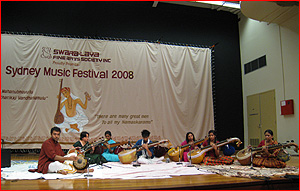
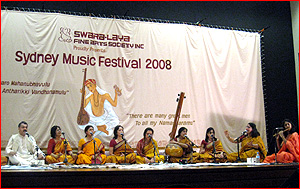
Sudha Raghunathan drew a large crowd to the auditorium in the evening. Sudha Raghunathan was just that, Sudha, a power on to herself. The audience got what they expected. Her imagination bloomed as she sang her items with her usual charisma and magnetic presence on stage. The audience lapped Sudha’s version of Mokshamu Galadha in Saramati.
She drew them further with her prowess and talent in Pakkala Nilappadi in Ragam Karaharapriya.
T.M. Krishna is growing in stature as a torch bearer of the Semmangudi Srinivasa Iyer tradition, and is highly respected as a musician in India today. He treated the Sydney audience with a delightful "Ekkaalatthilum" in Raga Nattaikurinji, which was followed by "Ethavunnara" in Ragam Kalyani where his kalpana swaras flowed with effortless ease. However coming towards the end of the day, the audience consisted of mainly die hard T M Krishna fans who waited all evening to listen to his melodious travels, encouragingly amongst them were many young singers and percussion masters of Sydney. The accompanying artists Shrimushnam Raja Rao and Varadharajan on Violin made his music pleasing to the many vidwans and intellectuals in the audience.
Dr. B. Vijaygopal’s total control and command of the flute was evident through out his concert the next morning. The kriti "Rama Katha Sudha" in Raga Madhyamavati was a great start to the morning. He later changed to playing the Bansuri, equally efficiently as he explored "Nidhi Saala" in Raga Kalyani. An upcoming "A" Grade artiste who plays regularly in the Chennai musical circuit he succeeded in winning the attention of the Sydney audience.
The Carnatica Brothers gave a performance which was excellent, near perfect. Introducing the Ragam Thanam Krithi they launched into a pseudo kriti, RTP style of arrangement. Whilst this shows their ability to be creative, the essence of the ragam felt intercepted with this approach to many listeners. Nevertheless the catch of their concert was their well trained voice training and Ganesh’s ability to sing at the top Dhaivatham while sampling Swara Bedham in Ragam Mohanam during the explorations of a Papanasam Sivan’s composition.
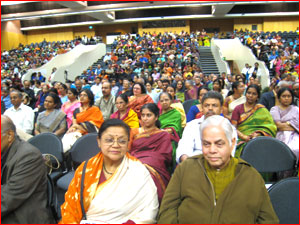
Unnikrishnan’s presence filled the Hall as not a seat was left empty. A multi-talented artiste who excels in several fields, he gave a crisp "Kanda Joodumi" in Raga Vachaspati. His "Kaarthikeya Kaangeya" in Raga Todi was sung with great feeling. Despite his straightfaced demeanour on stage, and the occasional nod at his accompanists, his effortless renditions without a crease on his forehead, won over the audience who gave him a roaring applause at the end. He was accompanied by Srimushnam Raja Rao on Mridangam whose accompaniment added zest and energy together with S Varadharajan’s Violin which complimented his performance. An enjoyable performance.
Aruna Sairam wins with Azhwar’s Bhakti
The Sydney audience burst into an uproar when she sang her first slokam in Tamil introducing the words, “Sydney Muruga”. Her Shanmughapriya RTP that followed was innovative: however what drove a full house to tears was her soulful rendition of Abhang in Megh Malhar.
She put new meaning to the importance of Bhaava to vocal music. Combining talent with devotion her rendition of the evergreen “Kurai Onrum Illai” preceded by the composition of “Kulashekara Azhwar” transported the audience into an ecstatic delight. Finishing off with a riveting performance of Kallinga Narthana Tillana, making light of her own style of keeping the “Taalam”, she left the audience begging for more. Critics were disappointed with her standard repeats; others however would have her sing nothing else but “Maade Mekum Kanne”. With a voice that grabs one with both hands she gave it to them with bucket loads of Bhaavam and Bhakti. A great finale for the evening. The audience buzzed around her as though she was honey, making it impossible for her to even get to her green room much to the delight of Jaya TV who grabbed every opportunity to film it all.
Shreekala Bharath’s Pennin Perumai was watched by most dance lovers at the end of the two long days. Despite some stage difficulties she was able to grab the attention of the audience. She excelled in bhavam.
The Festival ended with a debate held the next day which I stumbled into half heartedly. The playful discussion on Class vs Mass, Was Carnatic Music only for Connoisseurs or for the Masses, the debate was presided over by the articulate Sudha Raghunathan. The group in favour of Tradition were T M Krishna, Shrimushnam Raja Rao, Mannargudi Eashwaran and Ganesh of Carnatica Bros.
The group against were Sreekala Bharath, Ganesh and Kumaresh, and Shashi Kiran. A forceful argument was put by T M Krishna in favor of maintaining tradition, equally playful yet interesting were the arguments put by Ganesh.
I left wondering about the various implications of globalisation and the challenge that musicians faced today in balancing tradition with the modern in an ever changing world.
Knick Knacks: At a different level the organisor’s ‘no fuss’ approach helped to keep the Festival going and surprisingly on time, with minimum speeches. The sound engineer took up the arduous task of balancing sounds throughout the festival with élan, though at times it was too loud for people sitting in front.
Australia so proud of its Volunteers, saw them in attendance despite the rather grey and wet weather. They handled truck loads of food for the participants. The volunteers of Sai Youth Group took care of all entry, exits and stage arrangements. A separate room was dedicated to provide the privacy to hold radio and TV Interviews with the artistes.
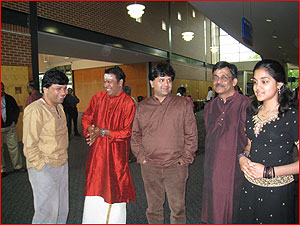
Those who wish to hear Aruna Sairam’s ABC interview may do so at http://www.abc.net.au/rn/musicshow/default.htm Winter colds and nagging household duties didn’t discourage enthusiasts either who came in silks covered by their overcoats, battling the rain and gloom to the University of Western Sydney, Parramatta. During breaks between concerts people were torn between socializing, taking autographs and photographs with their favourite artists, buying CDs and DVDs whilst others where happy to devour vadais, Idlis and Masala Dosai with the much needed coffee to stall headaches and head colds.
Swara-Laya Inc.’s venture for the second year has been a greater and grander success. The buzz now is that next year’s festival will witness more interesting and innovative dimensions to Sydney.