| ||||
| Madras University Music department celebrates Platinum Jubilee By Kutcheribuzz staff reporter / Chennai |   | |||
|
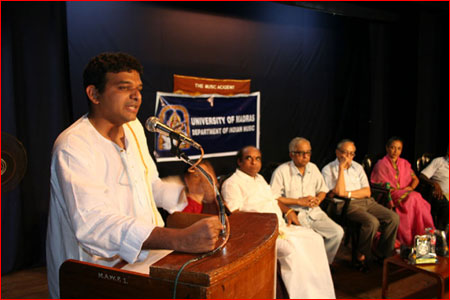
The Department of Indian Music, University of Madras jointly with The Music Academy, inaugurated the year long Platinum Jubilee Celebrations of the department on May 19 at The Music Academy Mini Hall, Chennai.
N. Murali, president of The Music Academy, presided over the function. Renowned dancer Leela Samson, director of Kalakshetra Foundation offered felicitations. She spoke about how the elements of rhythm can be challenging to the performing artistes and how rhythm when harmonious can be healing to minds of both rasikas and the artistes. The department announced a new course on Rhythmology and a symposium on percussive arts followed the felicitations. Dr. V. V. Srivatsa spoke on Textual traditions of rhythm. He quoted verses from Muthuswamy Dikshitar's compositions, Sangeetha Makarandam, a treatise written in the 7th century, Purandaradasa and Kalidasa that explained the importance of percussion and rhythm for music. He said that the name 'morsingh' has originated from the word 'murasangam' a percussion instrument of the early days.
Thavil vidwan Haridwara Mangalam A. K. Palanivel talked about Thavil as percussion and his experience of playing the Thavil not only for nagaswaram but also for other instruments such as violin, mandolin and saxophone. Vocalist T. M. Krishna elaborated in details about the rhythmic accompaniment from a musician's point of view. He expressed his opinion that the vocalist should be aware of at least the basics of percussion, as the whole concert is teamwork. He had brought samples of recordings to show how each veteran mridangist had their own way of enhancing the concerts. He explained how they established mood in a concert after the kala pramanam was set and how sangatis were built up along with the vocalist's development of sangatis. The samples included T. K. Murthy, Trichy Sankaran, Palghat Raghu, Umayalpuram Sivaraman and Palghat Mani Iyer. He treated the audience with a piece sung by T. Brinda and T. Mukta, where Ramaswamy Pillai played as least as possible but enhanced every aspect of the song. The Department of Indian Music, Madras University offers certificate course in music and dance and postgraduate courses in Indian music. The department also conducts endowment lectures periodically. For more details contact: 044- 25368778 - Ext No: 277 Web site: http://www.unom.ac.in/indmusic.html | ||||
 Kalidas explained about different schools of percussion in detail. He wondered at the reference of 'musicians' and 'mridangists' separately and reiterated that mridangists are also musicians as without them the concert will be incomplete. He talked about the indigenous Pudukkottai school and the Thanjavur school, which was influenced by the Maharashtrians settled in Thanjavur. He remembered Kallidaikurichi Mahadeva Bhagavathar informing about the korvais performed three times at the end of the avarthanam as were introduced by Pudukkottai Mamundiya Pillai.