| ||||
 Indian Dance in California |   | |||
|
Well known scholar, author and critic Sunil Kothari, attended 'Dance Conversations - Indian Dance in California: Past, present and future', a symposium held on May 21 and 22, 2005 at Ektaa Center, Irvine California.
He presented a paper with screenings of excerpts from choreographic works of Indian dancers/choreographers. In this column, Kothari shares his observations...
Conceived by Priya Srinivasan, a dancer, scholar and an Assistant Professor in the Department of Dance at University of California, Riverside, in collaboration with Ramya Harishankar and the Ektaa Center whose Executive Director is Harish K. Murthy, this unique event was made possible with support from Arts OC, Alliance for California Traditional Arts and the California Traditional Arts Advancement Program of the Fund for Folk Culture supported by the William and Flora Hewlett Foundation and the James Irvine Foundation.
Srinivasan and Harishankar originally conceived this event because they wanted to provide a forum to discuss Indian Dance issues in the US thinking about the past, present, and future directions. There were several inspirations that led to this conference. The first being the annual Thyagaraja Aradhana held in Cleveland each year, the second was the Flamenco Dance Festival in Los Angeles, and the third was the research done by Srinivasan to discuss the long standing relationships between Indian and modern dance in the US. Therefore they organized the conference to bring together gurus of Indian dance in California together with students, academics, and
American modern dance choreographers to have a conversation. They hope this will become a bi-annual event bringing together Indian dancers for discussions in the future.
This conference was a two day event including panels and symposiums during the day and one evening of dance performances by the leading dancers in the California region to further assess the situation and look into the future of Indian classical dance forms and how they will sustain, shape and live among the second generation of dancers viz., the children of the Indian Diaspora and also non-Indian students studying Indian classical dance forms.
Srinivasan and Harishankar wanted to feature this very important work done by Vaidyanathan and therefore began the conference by developing on this theme. The panelists were dancers / teachers - Kathak artiste Anjani Ambegaonkar (Director of Sundar Kala Kendra Kathak Dance School and Anjani's Kathak Dance of India, Diamond Bar), Ramaa Bharadvaj (Kuchipudi and Bharatanatyam dancer, Director Angahara Dance Ensemble, Yorba Linda,), Ramya Harishankar (Bharatanatyam Director of Arpana Dance Company, Irvine), Mythili Kumar (Bharatanataym dancer, Director of Abhinaya Dance Company of San Jose), Katherine and her husband K.P. Kunhiraman (Bharatanatyam and Kathakali, Directors of Kalanjali dances of India, Berkeley) and Viji Prakash (Bharatanatyam Director of Shakti School of Bharatanatyam
Los Angeles ).
The moderator elicited answers from the panelists about the manners and mannerisms, creating their own local tradition regarding dance, social pressures, extravagance, learning the technique and having mastered it branch off into expressing social and political opinions, angst, giving full freedom in a vocabulary mastered, as some of the dancers/gurus have seen a vast range of Western art and therefore they see no reason why the next generation should not express what they want to in a way they have mastered the technique.
Issues came up about what is new, what is creative, what the next generations must do, in any case they must master the technique first, be it Bharatanatyam, Kuchipudi, Odissi, Kathak, Kathakali, Mohini Attam and then they can have freedom to experiment/explore, innovate. It was obvious that every established dancer/guru wanted their students to master the technique and not to deviate from it. However, the question of free lancing, predominance of Kalaksehtra 'bani' style in case of group work in Bharatanatyam, solo dance versus group dance, quality control, parents' interest in their off springs studying dance and thereby inculcating Indian 'samskara', maintaining links with India, things Indian etc., were discussed. Training in Indian Classical dances was one of the strategies to achieve that goal, even when after a few years the young students gave up studying dance, on account of stress, further studies, and lack of time for practice.
"We had to practice for hours adavus, basic dance steps within a square, not allowing our outward band, 'kshipta' position of legs, move out of the boundary of the square drawn with a chalk stick on the floor. We had to study the music, the meanings of the Tamil padams, and work hard. Her discipline was strict. Those who survived received the best they could from such a great dancer. She used to talk and explain whenever we asked. But we did not ask many questions, because we knew the way she was teaching was a real answer to many of our questions. In retrospect now we appreciate it more and feel privileged that we were Bala's students. Those exacting standards are now a matter of past, but I see the flowering of Bharatanatyam and dance in general and we were trained to see all types of dancing. I had studied Manipuri from Nabhakumar Singh and, Bharatanatyam from Kumar Jaykar, a disciple of Meenakshisundaram, in Mumbai before coming over to study Chemistry (M.S.) at Stanford University also and Effort-Shape Movement Analysis under Irmgard Bartenieff and also Indonesian dances. All these training were useful as we could benefit from learning from the great masters. I was lucky to be exposed to excellent Karnataka music from Bala and Vishwanathan, her brother."
Medha Yodh reminisced about the early 1930s and 40s in India, the resurgence of Indian classical dances in India, the Indian National Theatre (INT), days of Indian Peoples'Theatre Association (IPTA), the contribution of Uday Shankar, Rukmini Devi, Ram Gopal, Mrinalini Sarabhai, Shanta Rao and others which paved way for others in SA to get acquainted with Indian classical dance forms. Today at 75 plus something Medha Yodh has been a mentor to several first generation dancers and also second-generation dancers, encouraging them to dance and see everything and supporting hem in their new works and choreography.
Robert Brown, the President of Center for World Music at San Diego was the second speaker. He had accompanied Balasaraswati during her American tour and had become a great fan and a devotee of hers, both as a great musician and a dancer. He reminisced about Bala, her early days in America, West Coast, her tours and his won commentary in English after Bala's Tamil rendition of padams, making the meaning of the padams accessible to the America audiences. The father of Modern American dance Ted Shawn had invited Bala to Jacob's Pillow. There were apprehensions about Bala's figure, off stage personality, art of abhinaya as she was coming for the first time to America. But her reputation as India's great dancer had travelled far and wide. And once people saw her dance and abhinaya, listened to her singing, they were won over.
It was an experience to see a rare Bala's rendering of 'Krishna nee begane baro', Kannada padam, well known for her inimitable abhinaya, just taken last minute before Bala was to return to India, gave all present a glimpse into the greatness of a tradition. Bala's own singing before dancing, and after the dance was over, the music continued, Vishwanathan playing upon the flute - the screening of the rare video left an indelible impression.
Indeed it is a rare document and should be kept in Sangeet Natak Akademi, Indira Gandhi National Centre for the Arts, New Delhi, National Centre for the Performing Arts, Mumbai, The Music Academy of Madras, Chennai and various dance departments of Indian Universities wherever dance is offered for MA and Ph.D. courses.
The third session was 'Intertwining histories of Indian Dance and Modern Dance'. Among the three panelists was David Gere, acting Chair and an Associate Professor at UCLA's Department of World Arts and Cultures, teaching courses in the area of performance theory, queer theory, and AIDS cultural analysis. He recently visited India for a period of six months for the three-year initiative on global HIV/AIDS and the arts project. He has special interest in Indian classical dance forms. The other panelist was Jennifer Fisher. She is a dance historian and on the faculty of the UCI Dance Department and originally obtained her PhD in Dance from University of California, Riverside.
Priya Srinivasan, the convener of the conference, explores the inter-relations between gender, immigration, diaspora, citizenship, and dance in the United States. She is currently working on a book project titled 'Performing Indian Dance in America: Interrogating Tradition, Modernity and the Myth of Cultural Purity. Her research work suggests the fundamental connections between the histories of American Modern Dance and Indian Dance in the United States. She has received training in Bharatanatyam under Chandrabhanu in Melbourne, Australia and has travelled internationally with his Bharatam Dance Company. She read her paper building up connections with Indian dance and American Modern Dance with the historical facts and the dances created by the American pioneer dancer Ruth St Denis and how she
had used the Indian persons to base her choreography including pieces such as Incense, Radha: Dance of The Senses.
She screened rare historical clippings from The New York Times of late nineteenth century and early twentieth century and the interaction with Indians by Ruth St Denis, gaining her own identity as a dancer, using Hindu worship and the element of spirituality, thereby saving herself from the stigma as a dancer in the West. Priya drew attention to the reports from the press about Nautch and Nautch dancers, whose dances were found repetitive and boring: Priya quipped: These Desi dancers of yore were reviewed d in this manner. No wonder nothing has changed. The criticism about Desi Indian dance in America is more or less the same!' David Gere supplemented Priya's screening with a documentary of Incense made on one of the disciples of Ruth St Denis. It was interesting to see this material. These histories are relevant and require study for the connection that exists between American Modern dance and Indian dance. Jennifer Fisher drew attention to Shelton's work on Ruth St Denis and also to the influence of Anna Pavlova on Rukmini Devi and La Meri's learning from Ruth St Denis and starting a studio teaching the Hindu dance in New York.
It is also interesting to note that under the British rule, the dance was viewed as a lurid art worthy of practice by 'the women of ill fame' (prostitute) and as a result of colonialism, with the brain washing of the Indians who prided themselves in the company of the British, aping them and their mores and manners, took kindly to Indian dances, not because in itself dances were/are great, but if the white, 'gora' people perform it, then it must be good! When Ruth St Denis performed specially for Gurudev Rabindranath Tagore in Kolkata and visited Shantiniketan in the late twenties, Tagore had invited her to teach Nautch/ Kathak at Shantiniketan.
A highly academic session it evoked great interest amongst the participants to know more about these connections between Indian dance and American Modern dance. How Martha Graham Doris Humphrey, the dancers from Denishawn company had studied Oriental dances, as they were labeled and later on Martha Graham developed her own style of Modern dance- how much she owed it to Hatha Yoga and earlier influences of Ruth St Denis form quite an interesting inquiry.
On 22 May, at Ektaa Center the first session began with Emerging Choreographer's Showcase. Parijat Desai, a former student of UCLA's Department of World Arts and Cultures draws on Bharatanatyam and postmodern dance to find 'organic connections between forms. She has of late moved to New York. She showed a few excerpts of her recent choreographic works presented at Anita Ratnam's The Other Festival held in December in Chennai, that gave glimpses into what the Dance Magazine has described. With her three members and herself performing, Parijat explores Bharatanatyam and her own training in contemporary dance, using specially composed and available music of musician Girija Devi with considerable success. Her own presentation illumined it well and during the dialogue session she showed how the work is
created.
Radha Carmen, a Mohini Attam dancer, also trained in Bharatanatyam, Kathakali, Kalaripayattu showcased her recently choreographed work using Guatam Bhsakaran's music with a composition on Ganapati. She could not stay back for discussion. Had she stayed back the audience could have elicited from her reasons for using various dance vocabularies.
The group which has indeed emerged as choreographers is the threesome dancers, all students at one time at UCLA, Sandra Chaterjee, Anjali Tata and Shyamala Moorty, who have formed a Post Natyam Collective. They explore contemporary Indian dance and performance on a continuum of tradition and innovation, theory and aesthetics, art and activism.
They want 'to transport audiences beyond exotification, gender stereotyping, and strict dichotomies of East and West.' Individual numbers by each one of them showed what they mean to achieve through their presentation. Dealing with the issues of gender stereotyping, falling back upon their memories of childhood (Sandra in particular, coping with 'sexual trauma' performing before German audiences), Shyamala Moorty and she enacting the interesting number Sakhi, collaging of different dance traditions, Bharatanatyam, martial arts , modern dance and yoga, bringing in playfulness, humour, fun; Anjali Tata 's solo hinted at humour replete with feminist concern, using a wooden spoon doing daily chores a woman is expected to do and perform various duties, critiquing patriarchy.
Their group dance prayer to the haunting music by Nitin Sawhney 's musical score was riveting. They clearly showed what their generation can do, if they join hands and express themselves with the dance vocabulary they have. Though geographically placed as far away as Goa, Kansas and Los Angeles, they have emerged as a group with imaginative choreographic works, using their training of modern, contemporary dance and Bharatanatyam, Kuchipudi and other forms.
The discussion by Susan Rose, Chair of Dance Department at UC Riverside, Victoria Marks , Wendy Rogers, a choreographer and on the Faculty of Dance at UC Riverside, and the young dancers brought out issues of exposures to what is contemporary dance and how traditional Bharatanatyam vocabulary can be merged, in a seamless manner and what it means to create a dance movement. Very interesting and thought provoking. After seeing Post Natyam Collective's presentation, one of the members from the audience expressed her amazement at the empowered bodies of women and women power and energy and the healing quality of dance.
In the final open forum the participants gave their suggestions as to how to go from where they had covered the distance, and what lacuna they should overcome and make these conversations, dialogues more meaningful and far reaching. Robert Brown suggested that there should be quality control as far as musical accompaniment is concerned and an awareness about it as an integral and important part of dance; Prof Radhakrishnan of UCI offered to assist for discussions and issues of post modernism vis-à-vis other disciplines and comparative studies, Ketu Katrak also agreed to act as a rapporteur, to recap after the sessions were over, the present writer suggested
preparing report in print of the discussions, bringing out as a book, the need for the tech rehearsals before the performances, advance preparations of programme notes, to be announced, as Indian Diaspora carry on 'old habits', never read the programme notes,; there is strong need for 'networking', managing to rope in parents who wish to have links with India and enlist their support as volunteers, make documented material available to research scholars for further studies, and have collaboration with the Universities, whereby several facilities to stay together with artists and scholars in hostels, can be made available. Last year in October, 2004 Anila Sinha Kathak Foundation arranged the first international Kathak conference in Chicago in collaboration with Chicago University and international House, Therefore all participating dancers, scholars, musicians could stay together, which created a friendly ambience and one was not bogged down with too many administrative problems. Such initiatives should receive widest coverage.
For more info on Ektaa Center, check out www.ektaacenter.org or call (949) 300-8912
Sunil Kothari, who is now touring the U.S.A can be contacted at sunilkothari1933@yahoo.com.
|
||||
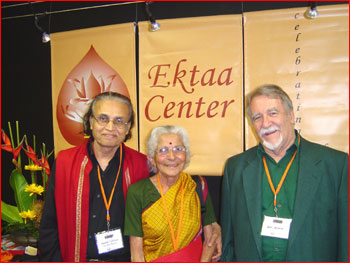 Organized by Ektaa Center, Irvine, California, on May 21 and 22, 2005, at the Ektaa Center's large studio, at Richter Suite 105, next to Buddhist Temple, the conference and the festival of dance at the auditorium at Civic Center Drive, Bellflower, received an enthusiastic response from the local dancers, their students, parents and academic community of the University of California, Irvine (UCI), UC Riverside, and the UCLA, Department of World Arts and Cultures, Los Angeles.
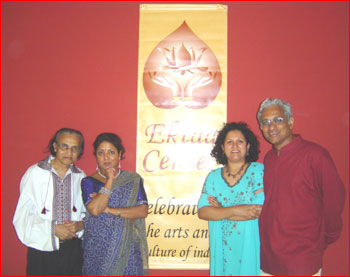 The first session titled 'Shaping California: Indian Dancers and their Voices' was moderated by Nirupama Vaidyanathan. In the year 2003 Nirupama Vaidyanathan, a disciple of Swamimalai Rajratnam Pillai and Kalanidhi Narayanan and Artistic Director of Sankalpa Dance Foundation at Fremont, California, had received a grant for a project to tell the story of the Indian- American dance community in California. She headed the project and conducted oral history interviews of dance gurus and others documenting the successes and struggles within the dance community.
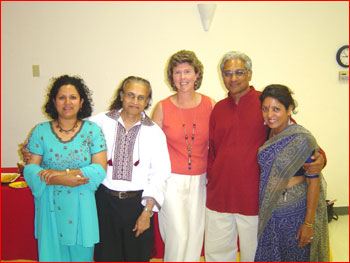 The second session - Balasaraswati and the early years of Indian dance in California was indeed the highlight of the conference. Conversation with veteran Medha Yodh moderated by Ketu Katrak, Chair of the Department of Asian American Studies at the University of California, Irvine. She has studied Bharatanatyam under Medha Yodh, an early and direct disciple of Balasaraswati. Medha Yodh studied Bharatanatyam from Balasaraswati from the year 1962 , when Bala came to America. Later on from 1976 till 1991, she taught Bharatanatyam in the Dance Department of UCLA. It was down memory lane and a recall to the Halcyon Bharatanatyam when Bala was in USA and those lucky few whom Bala gave a lot of time and a glimpse into the way Bharatanatyam training was transmitted.
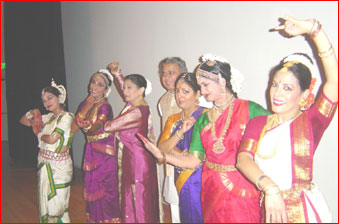 Those were the great days of interest in America in Indian dance and music, Louise Scrips and her husband forming the American Society of Eastern Arts and exposure to Indian and Indonesian Arts, the resultant institution like Center for World Music at San Diego, Bala's brothers Viswanathan coming over to Wesleyan University to do Ph.D. then teach there, Bala's brother Ranganathan playing mridangam, Bala's guru Kandappa's son Ganesan accompanying Bala for nattuvangam, the entire orchestra of extraordinary high standard, the like of which is now rare to come across, John Higgins studying Karnatak music as a vocalist and he was known as Higgins bhagavatar, Robert Brown himself learning mridangam and Veena and the following Bala, her brothers received in America, Bala's own daughter being trained first in vocal classical Karnataka music and then in dance and abhinaya for padams, her settling down in USA, marriage with Douglas Knight, who too studied mridangam and their son Aniruddha studying and performing Bharatanatyam, the grand son of Bala, the entire narrative was rare and not known to the young generation of dancers in America.