| ||||
| Soaking in dance at temple town By KutcheriBuzz staff / reported from Thennangur |   | |||
| The GST (Grand Southern Trunk) road is a well developed highway today. With suburban colonies growing at a rapid pace outside the south Indian city of Chennai, the volumes of traffic on the GST has also grown.
It takes us an hour to get outside the city and snake our way out of Tambaram. We are on our way to Thenangur, on the fringe of Wandawasi, which the British called Wandiwash. The place is about 110 kms from the city and it is here that an annual workshop camp is held for dancers by Natyarangam, the dance wing of the city-based Narada Gana Sabha. We leave the GST and take the road to Uttiramerur on a moonwashed night and arrive at Thenangur just after midnight. The watchman has a room ready for us and had we checked in an hour earlier, even got a hot cup of milk. Thenangur is home to the mutt founded by Sri Haridoss Giri who attained samadhi a few years ago and was known world over for his discourses and namasankeerthanams. Today, in this quiet village, is a sprawling temple that encompasses the architecture of Orissa, the Pallavas and the Cholas, a home of the aged, a health care outpost and a farm, besides lodging facilities. Led by advocate and arts promoter R. Krishnaswamy (of Narada Gana Sabha, Chennai) and a smart team, the facility is managed very well. We wake up at 5 am, being told that the men and women attending this camp (this year, the focus is on training dance teachers) will start their final day of the three-day workshop, with yoga. But it is a lazy Sunday start. The previous night was a grand colourful one of celebration. It was a day for Garuda seva procession at the Sri Pandurangan temple. Palanquin bearers from Chennai and a nadaswaram family from the same city has been brought here to create a wonderful experience. And as is the tradition, the gurus and sishyas at the camp, had joined in the procession and even danced away into the night.
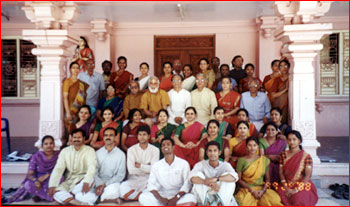
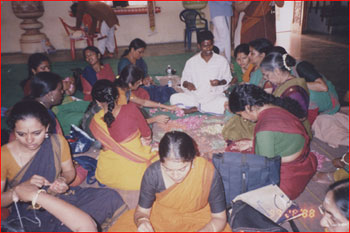
Obviously, they were tired. It showed on their bodies as they carried steaming hot water for an early bath and then refreshed with a hot cup of coffee. The hospitality is first class here. Everybody talks about it. And about the rich, tasty food served by the well known Mookambikai Caterers. They joke that most people here would have added a few kilos to their weight. Everyone flashed the 'V'sign. We are amused. Does it stand for 'two leaves', the symbol of the AIADMK party, now ruling the state. Or for victory? A camp volunteer tells us it stands for 'Radhe-Krishna'. Involuntarily, we too flash the sign as we file in for breakfast after the yoga session. After a padha puja to the memory of Sri Harisdoss Giri, the group adjourns for breakfast - iddlis, dosais, pongal, vadas, sweets, coffee. Sujatha Vijayaraghavan of Natyarangam, the host, tells me that besides sharpening the skills of dancers in a serene atmosphere, the idea of holding a camp in a temple campus is to motivate people to get dance back to the temple and treat it with more respect. This is the sixth edition of the Natyarangam camp at Thenangur. Usually it is held just after Pongal festival in January. And about 50 people sign up for a small fee. They are transported to the site, introduced to colleagues and gurus and to the agenda at an ice-breaking session and then put through a rigorous schedule from 5.30 am to 10 pm for two days. This year, the workshop was conducted by dance gurus Prof. C. V. Chandrasekar and Dhananjayan and his wife Shantha, Dr. S., Raghuraman, a professor of Tamil, Rama Ravi, a specialist in padams and former teacher at Kalakshetra, artist A. Nagarajan, brother of the late dance guru Krishnaveni Lakshmanan and his wife and yoga teacher Gomatheeswaran. They take turns to hold classes, very interactive, in the huge, decorated hall where bhajans are held. Prof Chandrasekar has practical, firm suggestions that Sunday morning. "You should learn how not to exaggerate when you dance," he says. Dancers Sangita Isvaran, Vasantha and Roja Kannan step out to dance - 'Yaar poye soluven . . .' Sangita wants to demonstrate how departures can be made from typical movements. Says Chandrasekar,"When you use the mudras give them a lot of dignity. if you cannot, don't use them." The sishyas form two groups and each goes on stage. 'Padari varugidhey . . ' sings Rama Ravi. And repeats it differently for the second group. "They are asked to respond to the variations and nuances in the music," explains Natyarangam's S. Janaki who works at Sruti magazine. "Many dancers are not well versed with the music and this session exposes them to it." Tender coconuts are offered during the break. A final rigorous practice session follows. Then they wrap up. And certificates for all including five young men, and a dance teacher at Rishi valley school in AP. "The sessions are very intensive so we should have the heavy stuff in the mornings," suggests senior dancer Roja Kannan. "We loved the hospitality but we could have less of the food," says another participant. "We can only take 30 people on a camp," says Sujatha of Natyarangam. "It takes us three months to plan this camp." "We love the thinnai discussions that we as organisers and the resource people have late into the night," chips in Janaki. The lunch is a big spread. And it ends with a lovely iced kulfi and then paan. Meanwhile, the kalyana utsavam ceremony begins inside the temple where the gorgeous alankaram for lord Pandurangan, is changed every day and every ritual is rich in song, recitation and act. The camp participants sit through the 90 minute ritual, receive blessings and pack up. Another Natyarangam dance camp comes to an end. If you want to know more about the camps, contact Narada Gana Sabha at Ph: 044-2499 3201. | ||||