| ||||
| Buddha Jayanthi Festival in Hyderabad By Dr. A. Ramayya Mulukutla / Hyderabad |   | |||
 | ||||
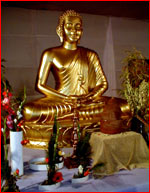
Buddha Jayanthi was celebrated from 2-4 May 2004 in Hyderabad where Buddha occupies a place of pride. As is well known, Andhra Pradesh has some 50 Buddhist archeological sites, the most famous being Nagarjuna Konda and Amaravathi. In the middle of the Hussain Sagar lake at the center of Hyderabad, a 320 tonne, 17 meter high monolithic statue of Buddha was installed in 1992. The Peoples Plaza complex, which has an open-air auditorium on Necklace Road girding one side of the lake, was developed in the last five years to conduct cultural programmes for the general public.
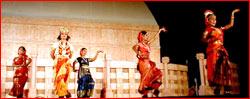
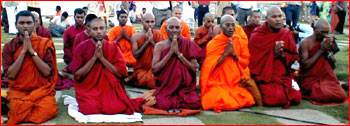
It was here that the Department of Tourism of A. P. showcased dance dramas on Buddha's life in three different styles, that is Bharatanatyam, Odissi with folk flavour, and Kuchipudi. The programme commenced with Buddhist Monks from Tripura, Laos and Vietnam chanting prayers at the giant Buddha statue in the middle of the lake. Stage settings with Amaravathi Stupa in the background was specially constructed for the occasion.
On the final day of Buddha Purnima, Andhra Arts Academy of Vijayawada presented their Kuchipudi version of 'Gowthama Buddha'. Polavarapu Koteswara Rao's script and direction won accolades. This presentation had live orchestra, with music provided by K. Suryanarayana. Although all the dance dramas were on the life of Buddha where Prince Siddhartha, having seen the travails of his subjects, becomes a monk and then gets enlightenment under the Bodhi Tree and starts propagating the principles of Buddism, each was unique in its own way. They depicted diverse incidents in the life of Siddhartha as well as Buddha. The lyrics were in three languages - Sanskrit, Hindi and Telugu respectively. Costuming reflected the different dance styles too.
A.P. Tourism Department and especially, Kishan Rao its Director are to be congratulated in presenting this programme, which portrayed the life of Buddha in several contrasting styles of Indian classical / folk dance. | ||||
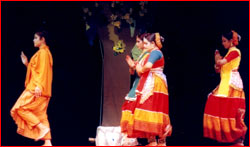 On the first day, Shankarananda Kalakshetra, Secunderabad, headed by Ananda Shankar Jayant
performed 'Buddham Saranam Gachhami' (this was their 30th performance). The programme was
based on Asvaghosha's 'Lalitavistara Buddhacharita'. Prema Ramamurthy was the vocalist for the
programme. This dance drama has been enacted at several places in India and abroad, including
Myanmar and Laos.
On the first day, Shankarananda Kalakshetra, Secunderabad, headed by Ananda Shankar Jayant
performed 'Buddham Saranam Gachhami' (this was their 30th performance). The programme was
based on Asvaghosha's 'Lalitavistara Buddhacharita'. Prema Ramamurthy was the vocalist for the
programme. This dance drama has been enacted at several places in India and abroad, including
Myanmar and Laos.
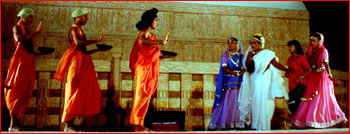
 On the second day, dancers from Kala Vikash Kendra Center of Culture from Cuttack, Orissa,
performed 'Goutam Buddha' based on Sir Edwin Arnold's work 'Light of Asia' and Janaki Ballav
Patnaik's 'Gautam Buddha'. This presentation was unique in that classical Odissi was blended with
folk dance traditions. This crisp and colourful presentation was performed before the Dalai Lama in
1995 during his 60th birthday celebrations.
On the second day, dancers from Kala Vikash Kendra Center of Culture from Cuttack, Orissa,
performed 'Goutam Buddha' based on Sir Edwin Arnold's work 'Light of Asia' and Janaki Ballav
Patnaik's 'Gautam Buddha'. This presentation was unique in that classical Odissi was blended with
folk dance traditions. This crisp and colourful presentation was performed before the Dalai Lama in
1995 during his 60th birthday celebrations.