|
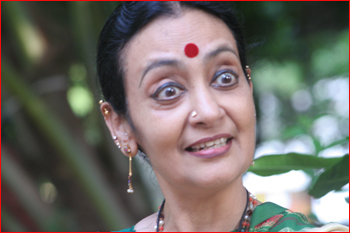
Prof. Sudharani Raghupathy, the eminent classical dancer and guru, is now devoting time to another interest. Of sharing her knowledge through modern media.
In the recent past, she and her team have joined hands with other facility providers to produce DVDs, CDs and albums on select themes. Sudharani says that these productions will hopefully preserve for posterity some of the unique features of Bharatanatyam.
In a recent conversation with Ashwini Vishwanathan of KutcheriBuzz, Sudharani traces her early days of teaching and her present pre-occupation.
Excerpts from the conversation:
 Being a performer, what made you get into teaching? Being a performer, what made you get into teaching?
In 1958, when I was studying in school I has a teacher who was the wife of the Head of the Theosophical Society in Bangalore. She used to get foreign students from New York. They were very much interested in Indian arts. One such batch was keen to see me perform.
I did a very informal performance with just a cotton saree and they wanted to know if I could explain whatever I was doing. To explain and perform was not in vogue at that time. Then they requested me to teach them. They wanted to come for classes to me. At that point of time it was not heard of for a young girl to teach. But Kitappa Pillai, my guru told me, 'You do it and I will encourage you'. That was wonderful.
Since the first batch of students was foreigners what efforts did you take to make them understand dance?
I thought them the adavus first but I had to analyse the movements myself first because they used to ask me a lot of questions regarding the hands and feet positions.
So I had to analyse the squares, the circles, the triangles, and the geometrical portion of the dance. It was very interesting to do it step by step for each adavu. Then more students came in to learn the basics and they would try the abhinaya for simple songs like 'Krishna nee beganae baro'. In 1964, at the end of my music college course, I had trained fifty to sixty students and this really helped me when I set my own school.
That is 'Shree Bharatalaya' . . .
I started the institution in 1970 when I just had one student. But by 1971, it started building up and since then I have always maintained only twenty five to thirty students all along . . . .
Do you handle all the classes?
For about two years now, I have not handled the adavu batches. I have trained my senior students who take care of it. I am always there to correct but I don't sit and take those classes. But for choreography especially the 'bhava' aspect I am always there.
When did you decide to stop performing in the margam format and go fully into teaching?
It's been almost five years since I have performed a margam. This is because I feel that I can't do what I did when I was twenty-five now. Even till forty five, I was in top form. Even now I can do a Varnam with cheating in the Trikala Jathi but not a Thillana or a Jathiswaram. It's too tiring. But I still do padams and javalis. After a particular age doing the bhava is more important. The emotions are very difficult to come as they come only through experience. The physical grind though difficult can be endured by everyone but only through experience and age does bhava shine.
You have released many dance-based DVDs in the recent past. What is the intention of all this?
In 1979 I presented the first ever television serial called 'Bharathanjali'; it was produced in the days of black and white TV. It was focused on the appreciation of Bharathanatyam. I then realised that children wanted to learn from it if they got copies but there were no copies as the tapes had got fungus.
In 1989, we did the programme when colour TV was the standard but we came to know that this tape is also not available freely.
IN 1997, Carnatic vocalist Sudha Ragunathan surprised us when, on the occasion of my fifity years of dancing in 1997, she sang ten thillanas of Madurai N. Krishnan's and gave it us as a present for release. Many well wishers and artistes said they wanted to see the visual side of this but Sudha had presented it as a song and not designed for choreography in dance.
But it was a challenge to my senior students and to me and we began working on them. Each was for three or four minutes and took us quite a long time to choreograph and then shoot it. We tried both group and solos and it clicked. But the main reason for releasing the DVDs is for posterity. This work is for artistes all over the world who are interested in Bharathanatyam. It is for them to increase their repertoire.
What feedback did you receive?
The feedback that I got was very positive but people wanted to see the Thillanas in its full form with the Mei adavus, Korvais and the endings. Therefore I have brought out two more volumes of the Madura Thillanas. The DVDs will go well with a foreign audience and people who are not very exposed to classical dance.
Does this production pertaining to any one style?
The DVDs are for dancers from different styles. There are a few differences in each style but the base is the same for all. I think all teachers must do this because we need more good teachers. The teachers are now very mediocre and I think they need to pull up their socks first. Teachers should have a good repertoire first in order to impart knowledge.
Was that the reason behind doing 'Madura Margam' on the traditional Margam?
People said they wanted a Margam from me. We had brought out a book called 'Madura Margam' and since there was a book, children could now watch the DVD and learn the Margam. I also think that senior dancers like me are the links for the future and it is important for us to do such things.
You have also produced the 'Navasandhi Kauthuvam' as a DVD . . .
Guru Kitappa Pillai taught the Navasandhi Kauthuvam to me in 1958. Vyjayanthimala brought it out as a book in 1964. But all the dancers may not know all the nine. Kitappa Pillai was very keen because I provided it as documentation to the Sangeet Natak Academi a long time ago. But the students of dance did not know the Navasandhi Kauthuvams and since Kitappa Pillai also passed away I could not produce it at that point of time. I got this opportunity recently; students from any style can perform the Kauthuvams.
So this product has also got positive feedback?
I have many students coming to me to do research on the Navasandhi Kauthuvams. The response has been very good. They want repertoire and I am very happy to have released the DVDs.
|