| |||
  | |||
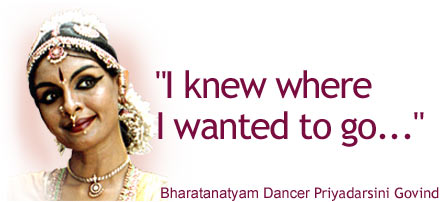 | |||
| A top class dancer, Priyadarsini Govind will receive the prestigious award of 'Nritya Choodamani' from Krishna Gana Sabha in December this year. A disciple of Kalanidhi Narayanan and the late Rajarathnam Pillai, Priyadarsini is known for her perfect dancing. The artiste who is currently on a whirlwind tour of the U.S., spoke to KutcheriBuzz in late August. (This is a very exhaustive interview and will need about 20 minutes for you to read it) You've been awarded the Nritya Choodamani which is considered a great honour for a dancer. But, there are so many awards and titles being given today that many seem to carry little value. What does this award really mean to you? I think awards and titles are important. It is an encouragement and it is also a way by which a dancer is known to the public. Programmes are on one side and on the other side it is the publicity. It is very important that your name becomes familiar. When your name is familiar, more people come to your programme and it is cyclic. It is very important that you are recognised. An award is a recognition. The moment we go on stage, we want to be recognised for our talent and the passion we put into art. It is each artiste's personal boundaries that she will go to - either she receives an award or to look for an award. Awards are measured by the reputation of the organisation that gives it and every award has some goodwill behind it. How much an artiste personally values the award is the respect she has for the organisation. This award is one of the best moments in my life. I'll always remember it. Because Krishna Gana Sabha is a place where I regularly performed even at a time when I was not performing much. How did you launch yourself? The worst thing that I think about me is that I could never go to anybody and talk about myself or ask for a programme. I've never been a 'PR person' and this worked against me very much in the early years because one is that you don't get visible and the other thing is that today it is the rule of the game in any profession that what you want, you have to ask for it. One is that you have to work very hard. The other thing is that if your goal is to perform, then I think today, it is a rule that you have to apply for it and talk to the sabhas and convince them. You have to prove yourself through your programme, that you're worthy of it. I could never go to a person and say, "Give me a programme". I was very shy to do it. This was in the earlier years. Now of course it is a routine, and as a matter of force you have to apply and tell the sabhas, that you'd like to perform. Isn't it depressing for an artiste to go and ask for a performance? That is what I used to think. In other fields, when you do a good job, there is an immediate response. For instance if you do a good project, I suppose it leads on to another. But, in this profession, it's not so easy. Every programme is a milestone. Every programme does not automatically lead on to another programme. If I have to perform again, though I may have done an extremely good job in the prvious performance, upto a certain point I have to work for it, looking for the right organisations, the platforms and making sure that an opportunity is given to me by talking and convincing them. Unfortunatley it is like that in this field, where people don't normally come to you and say 'you were fantastic and we give you a programme'. Very few programmes come like that. What is not right in Madras? I think art is very subjective. I might like something and another person may not like it. It is not really homogeneous. People have varied tastes. As a result, many dancers are liked by many people. If I want to approach somebody for a performance, there are already those many who'll get ahead of me. There is competition. Even if I'm extremely good, if I wait for opportunities to come to me based on my merit alone, I will definitely be left behind. But, one thing is very clear, if you don't have the merit, it very important that the first thing you have to work on is your art. Because, without that strength, you don't have the authority to approach people. You said you were shy to approach sabhas for performances. At what point did you make the transition? Was it very difficult? Did you get hurt? I have a very practical husband. I used to constantly crib that I'm not performing. He got tired of it. He said, 'If you want to do something go about it the right way. You decide what you want to do. If you want to be a dancer and if you decide you want to lead your life this way, then you have to work at it. Look at the pros and cons and see how far you want to go. And if you want to go that far, make sure you do everything to go that far. There is no point in getting frustrated'. But, that's where all of us go to at some point, when you feel you're not given your due, when you're not given a chance to dance and do what you really want to do. When I reached that point, I hated the situation that I was letting myself get into - being frustrated, being negative and constantly worrying. It was when I decided to take things in my hand and look at the positive side. When you decide to keep your face to the sun, you won't like any of the shadows. Every field has good and bad. I deliberately shut myself to the negative and went ahead and did what I felt needed to be done. Tell us what you did? It was a very crucial time, because I had decided to dance and I had lost my master. Dance is a visual art. Very often, the personal qualities that you exude and what you think in your mind does not always coincide with what a person sees. You cannot see yourself. I wanted somebody to sit in front of me, help me, guide me and bring out the best in me. I wanted to work together with someone and at that time I had lost me master. I met Lakshman, who is a very good performing artiste himself. And this was a really good time, because Lakshman and I are completetly into art and we love dance. Both of us are open and we like to try out new things in Bharatanatyam. Our style is traditional, and by new things I mean various permutations and combinations of movements. When we see something impressive in a dance performance, we immediately come back and try to incorporate it. We steal from everybody and try to adapt it. He was a tremendous boost. So, as the first thing I wanted to see how I worked my schedule and develop myself as a dancer. On the other side, when I was confident that I was going in the right direction artistically, I made sure that I met people and performed in the right basis. That combined with the changes I had made in my dance put me on the right track. What were the significant changes you made in your dancing? I was not very comfortable with the style of dancing that I was doing. It was nothing to do with what my master had given, but just the style of dancing that I had developed. I felt there was something lacking. So, we first worked on that. I felt I was not giving enough power in my dance. A certain strength in the movements and we worked on straightening out the lines in some of the adavus. We also tried new adavu patterns, which was something I had never done before. And I was working on something on my own and I had somebody whom I was completely in tune with, who could see and tell me if it came out the way we wanted it. Another thing is that I have learnt abhinaya from a very young age and I've been trained in abhinaya. But, with Lakshman, I also learnt how to keep the audience in mind. A lot of times, I also felt that I did not completely communicate to everybody. Because abhinaya is a very sophisticated language. But, if you can alter your thoughts with certain punches, you can communicate even to the uninitiated, because after all it is a poem's beauty that your'e trying to convey through dance. Does it dawn on an artiste like you that at some point you begin to think you want to go beyond what you're taught? It definitely happens. I think a dancer starts moving at every point she realises that she has to go beyond what she has been taught. At every point she starts thinking for herself, she moves. The moment she just interprets or reproduces what she has been taught, she stagnates. There is no creativity in it at all. Personally when I say I worked on my own, both my teachers - Swamimalai Rajarathnam and Kalanidhi mami, have both insisted that the creativity of a dancer is more important that mere reproduction. We have never been discouraged when we wanted to try out anything on our own. But, for some reason, when I was performing I never felt the need to try anything. May be I was slow. He was such a beautiful artiste that you would just imbibe what he taught. And he was a wonderful musician and his vision...these are all intangible things that you communicate. So none of his students were less than average. But that was what he gave us. But, I never moved beyond. But, with regard to my abhinaya, we were constantly working. Abhinaya is such an imaginative art. And with Kalanidhi mami, I started teaching abhinaya first. She felt that when you teach, you learn better. How do you do that? When you teach, you see in front of you what you have in mind. You begin to see if it looks good or bad. You start analysing if it works, if an adavu suits a person, you learn more about the adavu. Every person's body structure and ability to take in is different. When you work with different students, you learn many things, because that many minds and bodies are working. So, you learn many things about an adavu when you see it on five different students. Whe you realise it looks different, you learn how to adjust and make modifications to make an adavu suit that person's physical structure. So, I learnt a lot of my abhinaya after I started teaching especially children. They are very curious extremely analytical and frank and tell you exactly what they think of what you've taught. So, we were constantly working. And when I worked with Lakshman, I learnt how to give those punches for the common man. I felt I was more of a connoisseur's dancer earlier. What woke you up to make those changes? I knew where I wanted to go. I wanted to be a mainstream dancer and didn't want to be just a connoisseur's dancer. So, the minute I realised what I wanted to be, I worked towards it. And what was that? The ability to reach out to every person. So you decided that you wanted more people to see your performance and hence, made those changes. Is change easy? Over a period of time, when you find that an item has become popular and when the people like it and when somebody asks you to perform the same item again, then you try to think what is it about this item that gets through to them. You're always trying to guage the reaction of the audience and once you're on stage it is a fantastic barometer, you can find out if you've got through to the audience, you can feel the vibes. A lot of times I've realised something has not worked probably because of a lack of concentration. And this is a way of teaching yourself. With time, you may have found out that tastes have changed, that people have less interest and you didn't want to be only a connoisseur's dancer, is it easy to be in the mainstream? It's not really easy. Sometimes I may want to include items which I love very much, but if they are too heavy and do not go well with the audience and then I avoid performing them and choose simpler songs, where the melody or raga is already familiar and the sentiment expressed is more popular. Can you give us examples? Sometimes, when I perform abroad, I do take up very heavy Kshetrayya padams, where the tempo is very slow, the idea expressed is very subtle, there are wonderful audiences for it. But at other places, if an audience is uninitiated, and the interest is less, then if I were to doze them with a heavy padam which they cannot understand, then they would be put off by the Bharatanatyam programme, because I'm not stimulating their interest to come again. Here I would probably take up a Bhajan, where the music is simple and captivitating and the idea is simple-the love of a mother for her child and of how she thinks he is the best- this is something they would easily understand. When communication is complete where the person communicating is successful and when the audience gets what the dancer wants to say, then you make them want to come back. The interest is generated. You have added one more person to your audience. What is the condition in Madras, which claims to have an informed audience? The Madras audience get to attend a lot of music and dance concerts. Its a very difficult audience to please, because they see so much, that if you want to keep them to their seats, you have to work very hard for it. Do you learn from your experiences? Of course. From every programme, I learn. I think back on what the audience liked. I learn from the feedback, not just from the 'musical' people, but from anybody's comment, though finally I decide what I want to take. But everybody's comment goes into the analysis on what you've done right and what you've done wrong. Tell us something about your teachers. Kalanidhi mami is like my mother. I took to dancing, mainly because of my classes with her. She has been instrumental in shaping a lot of my abhinaya. What does she do to you? She taught me to look at abhinaya in a very different way. What she has taught me is not just dance. A lot of my thinking has been shaped by her. Besides dance I've always been interested in the audio-visual medium. I took to mass communication after my graduation. I was planning to go to Sophia College after my B.Com., But, I couldn't take it up for two reasons - one, my father fell sick and the other - Kalanidhi mami was entirely against it. She insisted that I stay and study in Madras. She said that once I left dancing at that crucial time, then I would never come back to it or pursue it with the same interest. Other things would become more important. She said many people can do many different things, but if you like and if you're good at one thing then stick to dance. She has played a crucial role in major decisions, even like my marriage. She said, "You must get married now, don't delay it". She has been a guiding factor in all my decisions. Did she also help you to marry your interest and your dance? 'Broad-minded' is a very simple word to describe her. She says that the first thing you have to do is to put your own individual perception into dance. When you read a piece, she gives you total freedom to interpret it the way you want. So, she teaches you about creativity. It is very difficult to teach creativity. She constantly encourages you to do things on your own, to be self sufficient and to be open to everything around you. She says that every incident or everything that you see is a learning experience...don't shut your mind to anything. For example, she doesn't like modern dance. But she says that there is something in it for you to learn. Take what you like in it and adapt it to what you want. Even today, she attends all the programmes at Krishna Gana Sabha. She's an extremely disciplined person, very responsible...when she teaches you she accepts the full responsibility for you...she is one of the persons I admire. She is my yardstick. She is a Karmayogi. She can be very tough. Even today, I get scolded, but she is always pulling me up. I appreciate that and as you grow older, you want that kind of attention. What about Rajarathnam Pillai. Why did you go to him? I was sent to Rajarathnam sir by Kalanidhi mami. Earlier, I started out with a teacher called Usha and worked with her for three years. I had my arangetram under her, after which I was taken by Mr. Y.G. Doraiswamy to Kalanidhi mami. I learnt abhinaya from her for a year. She sent me to Rajarathanm sir. He used to come home and take classes. I started with him and I think it was a wonderful choice. He was a great musician and a very soft man. I learnt dance after a lot of pushing from my mother. I remember making faces and showing disinterest and sir would quietly sit through all this, which probably I would never do now. What did he pass on to you? It is the beauty of his imagination. The ability to respond to music. His style is very statuesque, with a lot of poses and beauty. He felt that we should always go with the music and not have jerky or sudden movements. He would say that the audience should feel pleasant and relaxed when they watch you...don't scare them. The style has to be pleasing to the eye and the ear. Actually, he was never a dancer, he was a musician and he was singing for Kamala and Vazhuvoor sir's class. But, all this is in the blood. By sheer observation, he would teach us. You now work with dancer Lakshman. What has he done to you? Lakshman is a person, with whom I have a total understanding and I respect his art a lot. I think he is one of the greatest dancers. He's got a fantastic imagination and his sense of beauty is amazing. We both work very well together. I've learnt a lot from him. Between us, it's a give and take. We're quite rude with each other in class. But what binds us together is our love for the dance. I've learnt from him on how to present myself to the audience, how to present an item. The sheer joy of working on an item, I learnt from him, because I never really worked on my own, since I was always under a teacher. I learnt how to work by myself with his help. Are you a satisfied dancer now? No. Of course not. I think it's like a child. When you keep this toy and say come this far and then keep another. The goals go on. There's no limit. I'm very greedy. I'm afraid to put it in words. I only know that now it is not enough. What is it that a dancer like you wants to do? As a dancer there are many many things that you want to do. We're never satisfied with what we're doing. The potential of this artform is that there is so much to learn and work on. Some people think you don't mince words... I thought I was very quiet. I keep to myself and hardly talk. I'd rather want to be known through my art than the talking. And so, you have achieved what you wanted? Yes. When you decide that you want something, the first thing should be to do exactly what you need to do. And it's each person's intelligence and way of looking at things. You should have the courage and tenacity to do whatever needs to be done. The problem that most artistes especially the dancers mention is about the huge lack of support...the willingness to sponsor or host festivals. What puts off most young dancers today is the issue of 'pay and dance'... We all complain about it. But when it finally comes to the practical aspect of it, nobody stops them. Everybody complains about it but everybody wants to dance. Certain things need to be done if you want to dance. Getting a sponsorship is an accepted thing now. The sabhas say that this is their only revenue. What about having an arts council that did all the work, recognised good dancers, watched them and then got the funders and provided a platform? Organisations have come up with that mind. But, after a point, they're not able to survive on that. There are many sabhas that don't take sponsorships. What would you suggest to young dancers? The bottomline is that if you are an up-and-coming dancer, who wants to perform and be visible, and be on the top, then you have to get your own sponsorship, if you want to perform in that particular sabha. That is the rule today. There is no other way. You have to decide. And what do senior dancers look for? There are a lot of considerations. When you perform regularly, and keep your dancing going, and as you present more of your programmes, you grow as an artiste. The other side is that you need the financial support and the programmes. Programmes are never enough. I would really like a minimum of atleast three to four programmes a month. Programmes are many but I mean good programmes, where you get a good qualitative and quantitative audience and you're also paid monetarily. As a dancer, one month you may not work since there are no programmes and the next month, there may be 5 to 6 programmes. It would be nice if it was spread out over the months. What is the future of solo dancing? Dance dramas seem to be popular... Solo dancing will never die out. When a dancer is on stage and she is able to express herself, or present items, without adjusting or working with others on stage, and doing it totally from her point of view, the satisfaction that you get from it is different. There are many people like me and in the generations to come who prefer solos. But, sometimes, there are organisations that prefer group dance productions, but opinions are divided. You haven't taken up teaching? I focus on my own performances and I have to push myself hard, that I don't really find time to take up teaching. At some point, won't you want to pass on your style to someone? I like teaching, but it's not one of my greatest interests. At the moment I'm not thinking about it. What about your international experience? I love to travel. Especially France and Germany have been very nice. They are more vocal about appreciating. They express it very well. You've been travelling very often... Often it is self financed. There are impresarios who arrange the tours. From the proceeds, the organisations pay for the tickets and orchestra. In the U.S., every month, there's somebody organising something. If you have a comment on this interview or wish to share anything, do mail us at editor@kutcheribuzz.com You can write to Priyadarsini Govind at gpriyadarsini@yahoo.com 'Nritya Choodamani for Priyadarshini Govind' Click here to read the story. | |||

| • Back to Interviews |
| • Your Contributions |
| • Your Comments |