| |||
 |   | ||
|
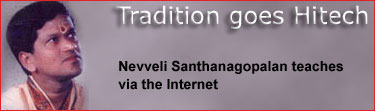
The learning of classical art forms has seen many phases. The traditional gurukula system of staying with the guru, serving him in his daily routines and learning when the guru intends to teach, visiting the guru's place at a mutually convenient time for both the student and the guru, through crash courses learning for a short time to go back with recorded tapes to learn at the students' pace and so on. With the advancement in technology, Carnatic music gurus are breaking down the geographical boundaries and are available on cyberspace for students. In one such initiative, senior Chennai-based vocalist Neyveli Santhanagopalan and Indiamusicinfo have joined hands to launch a e-learning programme. Traditional in approach but ready to use modern technologies, Santhanagopalan sees huge potential in creating music communities through online learning. He spoke to Revathi R of KutcheriBuzz at length about his venture. Excerpts of the interview: You are very particular about observing the traditional guru-sishya practices. Tell us what comes out of it. Any art form has to be transferred to the next generation. For that a gurukula system, a guru-sishya weaving is a must. Especially in music, to learn the subtle nuances, the guru has to be there at every moment of a student learning, practicing and performing. By doing a namaskaram to the guru, the mind and body get connected; the mind gets concentration and becomes totally receptive to what the students will be learning. Of course, these formalities are not necessary when there is total surrender to the guru by the sishya. The guru will also, at some level will feel that the student is equal to him. But the student should never feel so. During your days of learning, you used to travel from Neyveli to Madras. With technology making the learning easy, is the quality of learning as well as teaching still the same? I underwent a minor gurukula system with my guru T. N. Seshagopalan, when I came to Madras for studies and my guru whose headquarters was Madurai at that time used to come for his concerts. But when it comes to quality, it is the shraddha - sincerity of the mind that matters. My mother had learnt many kritis through music lesson classes put out by Vijayawada's All India Radio station in those days. If you analytically approach the learning system, it is possible to have the same quality. What prompted you to initiate e-learning? Actually it is divine will. I was teaching in the traditional way without prescribed fee and time restrictions. If one is to learn from the guru when he is in a mood of teaching unique things, then the sishya should be available for him. This aspect is missing in time-based classes. This aspect is taken care in the e-learning. If I feel fresh and come out with a creative phrase in a particular raga, say Kalyani, after a nap at home, I can record it and it can be made available on the Net. Such lessons are available as IMI specials for advanced students on the indiamusicinfo website. I feel the essence of gurukulam is captured in e-learning. That interested me. How does the e-learning system work? The student logs on to the website -www.indiamusicinfo.com/elearning. He is introduced to the lesson module. The audio samples are available to him/her to decide what to learn. Then you make the payment online and download the lesson. The lyrics are available in text format. A chanting of the lyrics is followed by a music lesson. We are particular about offering a affordable fee structure. Bharath Subramaniam, CEO of Indiamusicinfo, wants to offer the lessons free of cost after the company breaks even. We want more students to benefit. What type of students you think will benefit from this system? Anyone in the age group of 8 to 80 years! For children there are small songs and bhajans like sing-alongs. For advanced learners there is prescribed syllabus. We do not allow the user to download all the lessons at one go. After ensuring satisfactory progress, the lessons move on. We also have music appreciation sessions - all in audio format. Eventually, we want to bring out performers, teachers, connoisseurs and even sponsors. Are you the only guru who is teaching in this project? I am like a guide for the company. They are technically very well equipped. My ultimate desire is the specialities of different styles of music should be available in 'taught form' to all the students of music. It will happen some day. I will extend my co-operation to the company in achieving this. Even I encourage my students to learn kritis special to a particular school from the respective schools. Music learning is complete only when the student listens to all veterans. Were you teaching music using modern technologies even before this project? I was using voice chats and sometimes, teachingover phone. In voice chat, the teacher cannot imagine the student in front, though the student may be sincere as he is aware that the guru is listening. This is eliminated in e-learning. Thanjavur Sankara Iyer, the veteran teacher, used to teach veena, without actually playing the instrument. If the student understands what the guru teaches, any medium is good.
| |||

| • Back to Interviews |
| • Your Contributions |
| • Your Comments |