| |||
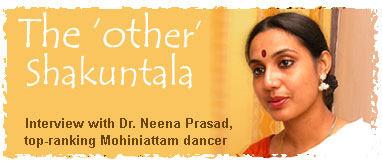 |   | ||
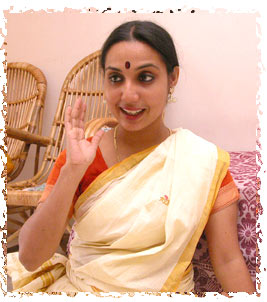
| Dancer Neena Prasad is one of the top artistes of Mohiniattam in India today. And is now a feature at key festivals, in India and abroad.
Having also trained in Bharatanatyam, Kuchipudi and Kathakali, the dancer is keen to share her skills. Neena shuttles between Trivandum and Chennai every month, training students in Mohiniattam, besides choreographing new productions and working on her own performances. And she is all set for a tour of the U.S.A and Canada in August-September 2004. Recently, at her dance school 'Saugandhika' in Chennai, Neena Prasad spoke to Aruna. S of KutcheriBuzz. You have trained in Bharatanatyam, Kuchipudi and Mohiniattam. What made you focus on Mohiniattam?
Slowly, I started giving solo performances in Bharatanatyam and I was given different roles in Chinna Sathyam's Kuchipudi dance dramas. But, I realised that Mohiniattam was also a great style when compared to Bharatanatyam and Kuchipudi. And I used to wonder why it lacked dancers and experimentation. I felt I should try and do something. What did you discover in Mohiniattam? I became a hardcore researcher and started collecting some of the lost items in Mohiniattam. I requested Kalamandalam Padmini and many others to teach me some of the old varnams and padams. And slowly I started choreographing new items. And in 1998, I gave a performance of a repertoire fully choreographed by me. Usually items in Mohiniattam are set either in Adi talam, Rupakam or Misrachapu. To start with I tried new cholkattus, which is the opening number. Here the syllables sung in particular ragas give the mood for the swaying movements. And I tried to use different varieties of talas. For example, my Pancha bootha cholkattu has Pancha jathi triputa talam. And we usually find the delicate stereotyped nayikas and the same mood. I also tried to experiment with new themes. You seem to be utterly fascinated with the daring 'nayika'? Mohiniattam is linked with the feminine psyche. We usually have the pining, dependent heroine. Women have so many emotions. Shakuntala was my first venture. It is a beautiful work of Kalidasa. I went through the entire text and I found that the nayika Shakuntala was hidden behind a veil. I wanted to portray the Shakuntala who is bold enough to question king Dushyantha. Initially I wondered if my body language would change. I wanted it to be fully rooted in Mohiniattam and didn't want it to turn into a theatric expression. She should be calm and collected, yet she should say what she is. And it was a memorable experience when I first performed at the Soorya festival in Trivandrum, 1998. It was the first recital that gave me the confidence. I also enjoyed my other productions, 'Amrapali' and 'Urmila'. You have worked on the 'adavus' (basic movements) in Mohiniattam. Tell us what you have done.
Your doctoral thesis has been on dance. Tell us more about it. My thesis was titled 'Lasya and Tandava in the classical dance forms of South India'. 'Lasya and Tandava' are the two modes of dancing and it is an age-old concept of the feminine and the masculine style of dancing. My research focused on how this concept dissolved into the regional dance forms. Bharatanatyam is a graceful style. But, the grace in Bharatanatyam is different from that in Mohiniattam. And in Kathakali, it is established that we don't use the chanda instrument when the female characters are depicted. During my research I found so many doors which opened...it took me five years to work on it, from 1995. What is the classical dance scenario in Kerala? Kerala is the land of highly classical artforms like Koodiyattam and Kathakali. There were very talented artistes. Once the state-wide youth festivals were started, the focus suddenly shifted, especially among the parents, teachers and students. Students would just learn one item to perform at a youth festival. And this performance also assured them an academic seat in a college. Slowly, mediocre teachers mushroomed. Video piracy is at its highest in Kerala. These teachers would watch videos or a TV channel and copy the dance choreography and teach it to their students. And now, with more media exposure, the scene is changing. After seeing the professionalism in other states, learning dance has become as serious as any other subject. You seem keen to also groom Mohiniattam dancers. . . I don’t want my tradition to be lost after me. I've faced several hardships. I've known teachers who were reluctant to teach. They would hold back in sharing their knowledge and experience... I want to leave something solid. I don't want to be only a successful performer and then fade out. This legacy of Mohiniattam should be taken to so many people around the world. In my own little way, if I can achieve that, then that is what I will cherish... Recently, I've established the Saugandhika institute for Mohiniattam in Chennai. And Chennai is the place where I was really groomed. And it is here, where I was inspired to go forward...I wanted to train students in Mohiniattam and help them appreciate the greatness of this art form. I also have a school in Trivandrum, where I train students in Bharatanatyam and Mohiniattam.
Students today are good at attaining technical perfection in dance. You can really carve a neat dancer with perfection. But what is lacking is their ability to imagine. I also feel that children today rarely dream! When we were kids we used to read stories from Amar Chitrakatha and Chandamama. And the colourful pictures in these books still remain etched in my memory. Poses of Nala Damayanthi are still vivid.... And you can imagine this when you portray it in dance. Students do try to imitate us, but abhinaya has to be creative. They need to be encouraged to read our literature. But today, children are more exposed to TV and cartoons like Mickey Mouse. For example, when I learnt the 'Ashtanayika Ashtapadi' from Kshemavathy, I used to observe her gestures and movements...but when I portray it, my imagination and depiction of the heroine Radha will be different from hers. While the mudras and the content will be the same, the touch is different. Your mother has played a key role in your career, hasn’t she? Oh, she is very strict and disciplined. When she sat down and watched me in class, I would be terrified. And now, she gives me full support, travels with me, gives her opinion on my new productions. And my musician Madhavan Nambudri, who is also a composer, contributes to my work. He can translate my ideas into music. Any projects that you're currently working on? I am planning post-doctoral research with a University in U.K. The subject is 'Post-Colonial Identity'. Dancers before independence in India, like the devadasis, had different audiences, and their constraints were different too. Today, when we perform on stage, our audience is different. We have the liberty to choose. Dance has always been influenced by the social set up at a particular time. During the feudal period, dance was performed merely to entice the feudal lords...
And my new production, 'Draupadi' will premiere during the U.S and Canada tour in August-September this year. Do you have comments to make or opinions to share based on this interview? Mail them to editor@kutcheribuzz and we will feature them here. Neena Prasad can be contacted at E-mail: dance@neenaprasad.com | |||
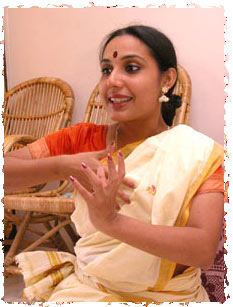 Earlier, it was my parents who took a lot of interest in nurturing my talent in dance. In Kerala, children learn dance for the sake of taking part in competitions and in the youth festivals. Slowly, after seeing performances of the great artistes, my parents felt I was not being groomed in the right manner. So, I was sent to Chennai after my 10th Class, in 1988. I started training in Bharatanatyam and Kuchipudi under gurus Adyar Lakshman and Vempatti Chinna Sathyam. But soon, I got a senior scholarship for training in Mohiniattam. So I joined Kalamandalam Suganthi in Kerala. I used to shuttle between Kerala and Chennai. And I went through a period of rigorous training. And in 1994, I received a senior scholarship in Bharatanatyam.
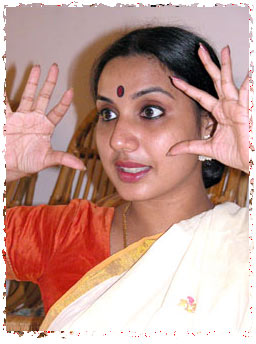 I started codifying all the adavus too, alongwith my guru Kalamandalam Suganthi. Since I had learnt different styles, from Kalamandalam Kshemavathy, Leelamma and Ramani I wanted to systematise what I learnt and added my own movement patterns too. And now I have categorised all the adavus and we follow a set pattern. And in Mohiniattam, the adavus should slowly flow from one to another and there should not be a jerk between them.
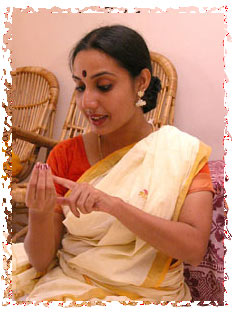 What is the difference you see in the students today?
 Slowly the scene changed, there were sabhas, many girls from affluent families took up dancing. Mohiniattam has gone through a lot of changes too. In my view, the past two decades are very important in the history of Mohinittam. Whatever happened in Bharatanatyam, Kuchipudi or Odissi in the 60s and in the 70s, happened in Mohiniattam much later. And the changes reflected in the themes and in the nayika. Till the eighties, we had the stereotyped nayika, mostly the ‘Vipralabdha' or the 'Virahotkantitha' (the heroine who is pining for her lord). In fact, probably for the first time in Mohiniattam, it was Bharati Shivaji who portrayed a Khanditha nayika (the heroine who questions her lord). So, my focus in the post-doctoral research would be on the contributions made to Mohiniattam, by present-day artistes..

| • Back to Interviews |
| • Your Contributions |
| • Your Comments |