| |||
| Meeting Of Music, Musicality And Maestro's Contributed by Sumi Krishnan, Sydney, Australia |   | ||
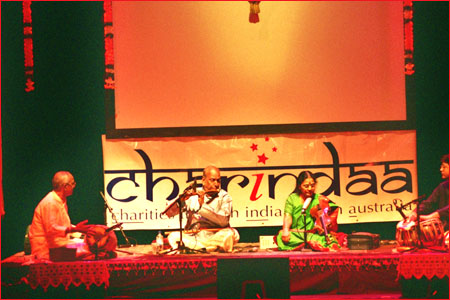
Friday the 18th of Aug 2006 in Sydney was yet another end to a long hard working week. It was a day to rush home contemplating not only the welcoming warm arms of dear and near but the inviting arms of our couches and a takeaway meal.
For some of us however, and the emphasis being on some, this Friday was different. We were the not so large group of people who braced the cold winter August evening winds to listen to two great virtuosos, Flautist DR. N. Ramani and eminent violinist, Dr. N. Rajam presenting a duet, a jugalbandhi enveloped by the rhythmic excellence of the mridangum (a south Indian percussion instrument) played by the eminent Mannargudi Eashwaran and tabla (a north Indian percussion instrument) played by the equally talented Mukundraj Deo.
What better point could that be than to commence the concert in praise of Lord Ganesha in Raga Hamsadhvani, a raga popular to both styles. The composition played by N. Ramani was Vathapi Gana pathim, a popular kriti set to an 8 beat cycle in Adhi Thalam. In keeping with the South Indian Tradition Ramani set the mood for the evening with his upbeat interpretation of this kriti. His sangathis were far from the more common versions one gets to hear establishing his style, imagination and mastery. This was closely followed by the lilting sounds of the violin by N. Rajam rendering the North Indian version of "Jaa Thow sey nahi boloon Kanhaiya" placing greater emphasis on the purity of the notes and the subtle movements in the Raga particular to her style. The two well-recognised pieces were welcomed heartily by the audience. The artists presented their styles at time alternatively, at times coming together, communicating with each other openly, with their eyes, hands and sometimes even stopping themselves in time to allow the other musician to play forth. Clearly, the audience was greatly warmed by their display of respect and reverence for one another and for each other's music. For those of us who therefore expected a pristine, automated, picture perfect performance, let us save these expectations for a well orchestrated conducted performance of a western kind. The basis of the musical styles for this evening was based on spontaneous improvisation with adherence to grammatical and rhythmic accuracy. The hall then resounded with the pathos of Raag Bageshree. N Rajam's alaap in this raga tugged at heart strings, leaving the audience spell bound. Considered to be a major raga in the North Indian Style this raga is relegated to the backseat and rendered at the end of the performance in most South Indian concerts. The artists dealt with this dissimilarity with expertise, offering a long presentation of alap in the Hindustani style, and shorter quick development of the raga in keeping with the Carnatic counterpart. The percussionists in the meantime explored swaping roles for a little period until they got a go ahead from both the flautist and the violinist to join them. The third piece was set to Ragam Kalyani or Raag Yaman. A 'ghana' or major raga in both styles the artists then settled down to provide us with a feast of their own interpretation and rendition of this raga. Sounds of the mellifluous Yaman then filled the auditorium. This piece was presented in the traditional Carnatic Style of Ragam, Thanam, Pallavi (RTP) or Alaap, Nom Thom, Cheez in Hindustani In the RTP, the composition is made up of a line that is completed within one cycle of a set of beats, and is later improvised upon alternatively by the artists. N Ramani therefore sang this one line set to Adhi Thalam showing the position of the lyrics and its arrangement within the rhythmic cycle for every one's benefit. Instruments were picked up and various improvisations then took place with the supported dynamism of the accompanying percussionists who sometimes played together and sometimes alternated. This long segment of the evening showed peaks of brilliance however at times left the listener with a feeling of incompleteness. The scintillating sounds of Yaman finished in a grand finale after a thorough exploration of various ragas in a ragamalika or a garland of ragas, introducing various moods and textures. Mannargudi Eashwaran on the mridangum and Mukundraj Deo on the tabla then took the floor. Both percussionists started with simple rhythmic patterns finishing with a long complicated rhythmic conversation, an outstanding display of laya, imagination and technical expertise all coming together for the grand finale. The audience was left wanting more. The concert concluded, in keeping with the North Indian Tradition, with the rendition of a short Bhajan in Raga Bhairavi of the North and Sindhu Bhairavi of the South. This concert shall be remembered by many for years to come. To listen to these maestros was to be surrounded within a cocoon of eternal space. For seasoned listeners, listening to a live performance holds the never failing edge, for others it would have been a pleasant evening spent for a greater cause, for funds raised were used for the purpose of eradicating blindness, building tsunami destroyed lives, or helping orphans. For yet others it may have been time spent elsewhere. However, getting the last word as always, it was not quite enough for me. Behind every successful event, is a successful organisation with vision. And Charindaa's (Charities through Indian Arts in Australia) efforts in organising the FIMA 2006 festival is duly appreciated and recognised. Our invaluable support to organisers such as Charindaa is essential for its survival and for Sydney to continue to reverberate with the music of the highest musical minds from the Indian sub-continent. <<If you organise such events or have enjoyed attending to rare concerts, you may share it with us. Email to us at editor@kutcheribuzz.com>> | |||
