"We hail from Karaikal. My mother Valliammal was 13 years old when she got married. My father Jagadeesan was a Nadaswaram artiste and was also involved in the activities at the Karaikal Ammaiyar temple. He died when he was 30. I was about six years then. Ours was a lower middle class family and we found it difficult to manage after our fatheršs death. Then we grew up with my uncle (mother's brother).
Vadhyar Ramiah Pillai (refers to dance guru Vazhuvoor Ramiah Pillai) was a paternal relative. He was a musician who also trained under his uncle Manicka nattuvanar. My aunts (father's sisters) were musicians and they used to give kutcheris. Ramiah Pillai used to attend their kutcheris and he offered to take us with him to Madras and teach us music and dance.
 It was during the II World War evacuation time (in Madras). Vadhyar preferred to stay in Madras at his house at Vadavoor Selvavinayakar Koil Street in Mylapore. There was a huge hall and several rooms and the house rent used to be ten rupees. We grew up in this house, along with his six children. I was about ten when I started learning dance. I stayed with him till I was about 20.
We never went to school. We had teachers who came home to teach us Thamizh and music. In 1944, I saw 'Baby' Kamala's dance at Mayawaram and was inspired. It was also a time when dance was banned from being performed in temples. Later, E. Krishna Iyer and Rukmini Devi revived the art and brought it to stage. There were sabhas that hosted dance programmes like Vanimahal, Indian Fine Arts, R. R. Sabha, Parthasarathy Swami Sabha. At that time, there used to be lots of plays.
Giving up dancing ...
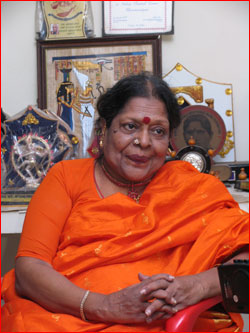
I had a desire to be a performing artiste. It was a time when Lalitha-Padmini used to dance. And even they who were so beautiful, performed only for a few years. Vadhyar advised me to take up nattuvangam at that time. He said that it would be useful for me throughout my life. He asked me to give up the desire of performing and asked me to concentrate on nattuvangam. He said that I would be a great dance teacher in the future. And today, I'm known as the first female nattuvanar...
It was a little difficult for me to digest the fact that I had to give up dancing. I was only 22 then. And if you had to perform, it was quite expensive too. The other dancers had their parents who were affluent and who could support them. A costume, which costs about Rs.10,000 these days, was atleast five hundred rupees at that time. We didn't have that kind of money. Vadhyar used to buy clothes for us. Pattu pavadai and davani was ten rupees and he used to buy these for us for Diwali. Even now when I teach, I think of the way vadhyar used to teach us. Old pieces are always interesting. Adavus and repertoire are the same, be it any style - either Vazhuvoor bani, Pandanallur bani or Rukmini Devišs style. Just like how Thyagaraja kritis are universal. Only a few variations in teaching marked the difference. There was a certain grace in the way vadhyar taught us to execute the movements. There was a mass appeal in his style of dance.
He used to like the varnam on Brihadeeswarar. He used to insist on angashuddha, posture and araimandi. His facial expressions were so impressive. The way he used to walk was so dynamic. He is unparalleled in the way he used to recite the jathis. His voice was so powerful. There were modulations between every line of the jathi. We learnt only by observing and by improving ourselves on our own. He would just think and recite a jathi and never wrote down anything.
In those days, the nattuvanars used to know many languages like Sanskrit, Telugu, Kannada, Tamil . . . They would equip themselves before they started teaching. We used to be immersed in the art.
Costumes called 'salla dress' ...
Costumes were very beautiful those days. It was called 'salla dress'. The dancers never wore too much make-up. They were all 'rupavatis' (beautiful women). When Pandanallur Jayalakshmi came on stage, she looked like a goddess. She was (dance guru) Meenakshisundaram Pillaišs grand-daughter. With all the 'thalai saamman' and jewellery and costume with a zari border, she looked so impressive.
At a time when she was performing so well, she got married and became the Sivaganga rani and gave up dancing after that. There were so many dancers who performed at the Thanjavur Brihadeeswarar temple, but are no more today. When these dancers entered the temple, a 'parivattam' used to be tied for them, and a 'poorna kumbam' would be given in their hands. They used to perform the 'Navasandhi Kauthuvam' and the nattuvanars would play the cymbals behind them. They were highly respected for performing this divine artform. Later, they were called devadasis, and were reduced to nothing... Some of the dancers I have seen, besides Jayalakshmi, are Bala, Kumbakonam Bhanumathi, Sulochana, Gowri amma. . . they were all so talented. In those days, women from the agraharam would never come and see their performances.
Nattuvanars move to Madras ...
By the 1950s, dance was accepted by one and all, there was a lot of interest and many girls took to dancing. Nattuvanars moved to Madras and sabhas started promoting dance.
In those days, the girls commenced their training in dance only when they were eight or ten years old. There was a special ceremony to commence the training. For almost three days before commencing the training, the girl would be given special care and attention.
In the morning, the dancers would take curd rice with onion before practice. Arangetrams were held in the temples. Dancers would need atleast a minimum of eight years of training before their first performance. It would take atleast three years to complete learning and perfecting the adavus. I've choreographed for films too. Saroja Devi used to like me very much. You could make money in films but their time schedules were so erratic. I was happy with teaching at home.
I did not marry... I had a huge family to take care of - my sisters. I got them married and I've also taken care of their daughters."
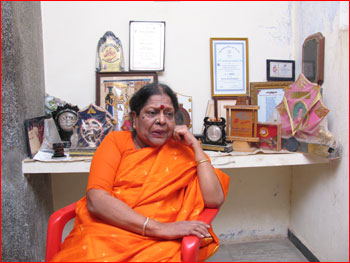
K.J. Sarasa teaches at 'Sarasalaya' her dance school on Rani Annadurai Street, Mandaveli, Chennai - 28. You can contact her at Ph: 044-24939677.
Did you like this column? Mail us your feedback. Our e-mail: editor@kutcheribuzz.com