| ||||
|   | |||
|
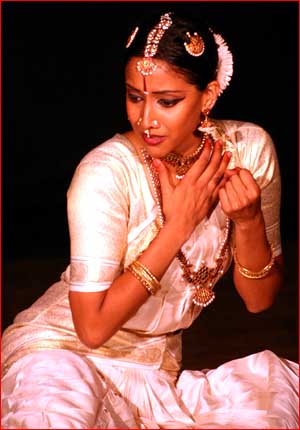
Bharatanatyam dancer Mythili Prakash was based in the USA till recebtly. But now, she works out of Chennai. Recently, Mythili premiered her new production called 'Stree Katha', the story of three women in the epic Ramayana in the USA. Mythili Prakash wrote the original scripts for this production which will be performed in July and August in the UK and the USA.
| ||||
|
Why is the Ramayana epic one of the most popular oral traditions?
Since I can remember, I have lived the story of the Ramayana through Amar Chitra Kathas (comics), as a bed time story told by my mother and grandmothers, as stories performed in dance productions, and even in real life comparisons – "Be an obedient son like Rama….., "Don't behave like a rakshasi [demoness] like Shurpanaka!" Over the years of growing with epics such as the Ramayana, I have come to regard the stories as more than complex and drama-filled narratives, but rather as deeply layered life lessons. Due to the universality of their messages, mythology and traditional epics are important cultural tools that are passed through the generations.
The story of the Ramayana is not just the story of Lord Rama and his valorous deeds. It is the story of so many people, whose lives were affected through the various incidents, and whose own decisions and actions were the catalysts for those incidents, which form "The Ramayana" as we know it. Stree Katha, is a tribute to three such people. The stories of three powerful women, three tragic heroines, all of whom in some way or another played a large role in shaping the The Ramayana. The stories of three women who have lived in our imaginations for centuries, yes, but who live as a part of each and every woman today.
The three women I have chosen for this production are Keikeyi, Shurpanaka, and Sita. Although the story of Sita is commonly the most explored, the focus given to heroine Keikeyi is uncommon, and the treatment of Shurpanaka as a woman of substance is extremely rare. Keikeyi: an individual of beauty, affection, intelligence, and strength, who unfortunately found the need to validate her status in relation to a man. Her story is that of a power-driven individual, perhaps similar to a high-status corporate woman today, who put aside her personal values and conscience to maintain her position of "power." Shurpanaka: the equivalent of a modern, liberated woman who does not hold herself to the societal expectations of feminine beauty or behavioral conduct. She believed that her beauty, femininity, and individuality lay in her power within, an inspirational motto! Yet her confidence and candid approach was frowned upon by society then and even today…. Sita: considered the "ideal woman" – a symbol of beauty and quiet strength, but most importantly a loyal wife, and woman of dignity and restraint….the epitome of society's expectations. Possibly the most tragic heroine, she made all the "right" decisions out of complete respect and self-less love for her husband. Isn't it ironic that her integrity was questioned time and again? Stree Katha encourages us to consider the stories of these women, and through them, examine our self-imposed societal expectations. Are these expectations fair? Do they stand in the way of our happiness? Do the stories of these women still happen today? |
|
|||
|
I have written an original script for this production. The lyrics have been translated and music composed by Debur Srivatsa of Bangalore. My first performance of Stree Katha premiered in Orange County, California in early May, 2007. This solo work was called "a work in progress" and was performed in an experimental setting, the venue - a three-room dance studio.
Each section began with a pre-recorded narration, consisting of two parts: the first part– a mother narrating to her child, incidents from Ramayana as they are popularly told, the child interrupting with questions (perhaps a reflection of my own thoughts); the second part – my own interpretation these incidents and their links to contemporary society.
Many audience members came back to see the show all over again. Stree Katha has had a wonderful beginning, and I hope and pray that it grows. The next performance of this production is on July 22, 2007 at Theatre, The Lowry, Pier 8, Salford Quays, Manchester, United Kingdom. It will also be performed in Venice, California from August 17 th to the 19th at The Electric Lodge. Dancer Mythili Prakash can be contacted at the email id - mythilidance@yahoo.com |
||||